
RELEASED NOW Technical whitepaper / blueprint addressing # CADT Pillar 4.3 50,000 words
AT Protocol Government and Defense
Eliminating the administrative ‘Vampire Hop’ through native XRPC revenue settlement.
The Relativistic Geometric Epistemic Logic of Sovereign Mesh
Authored by @jamesdumar via AT Protocol did:plc:7vknci6jk2jqfwsq6gkzu
[ez-toc]
“Modern governance is a Euclidean relic. It assumes that power is a static point in space. Relativistic Geometric Epistemic Logic teaches us that true sovereignty resides in the velocity and verification of the network. By migrating the state to the AT Protocol, we move from the governance of territory to the governance of the wave—creating a nation that is indestructible because it has no center.”
The Sovereign Rise: Why the Old will consume itself and the new infrastructure that will replace it globally.
The Evolution of Efficiency
| Feature | The Horse & Post Era | The Legacy Digital Era | The Sovereign Mesh (The Engine) |
|---|---|---|---|
| Philosophy | Physical routing of paper. | “Postal” routing of data packets. | Geometric Presence. |
| Bottleneck | The Central Post Office. | The Petroleum Server Farm. | The Solar Edge Node. |
| Friction | Highwaymen and muddy roads. | The “Vampire Hop” of fees. | Zero-Friction xRPC. |
The Village Hub: Internet Cafe 2.0
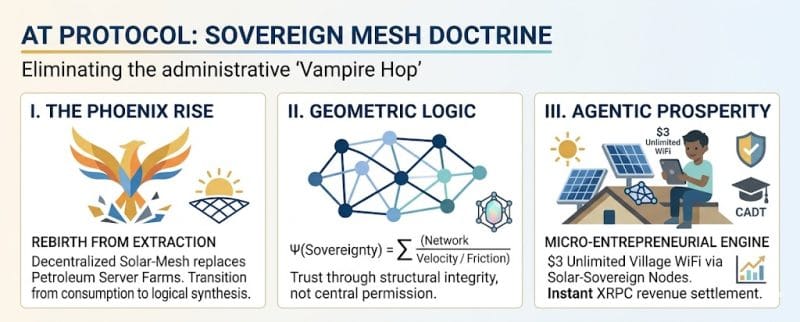
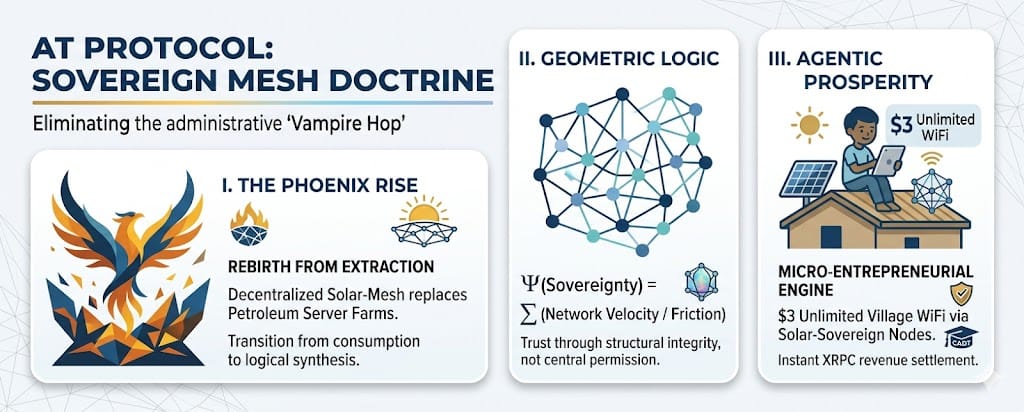
Think back to the early 2000s. The ‘Internet Cafe’ gave us a new way to live, but it had a ‘Horse’ problem: you had to go to it and pay by the hour. It was a destination, not a presence. Now, imagine a rice farmer’s son in Prey Veng. Under the Sovereign Mesh architecture, he receives a government-backed USD 500 loan to install a Solar-Sovereign Node on his roof.
It is plug-and-play. The second it breathes sunlight, he becomes a micro-ISP. He tells ten of his neighbors, “Give me $3 a month, and you have unlimited WiFi.” He doesn’t pay a telecom giant for the privilege of a line. He doesn’t pay for electricity. He settles his revenue instantly through the Sovereign Shield. Every rice farmer’s kid in Cambodia now has the capacity to find the money and set themselves up as a profitable node in the national mesh.
From Extraction to Synthesis
| Economic Pillar | Petroleum Standard (Legacy) | Logic Standard (Sovereign) |
|---|---|---|
| Resource Type | Finite & Consumable (Burned). | Infinite & Synthetic (Refined). |
| Power Profile | Centralized & High-Cost Grid. | Distributed Solar Autonomy. |
| Wealth Effect | Zero-Sum Extraction. | Positive-Sum Efficiency Synthesis. |
Architecting the Sovereign Knowledge Base
The transition from static information to Operable Intelligence is a forensic necessity. In the current digital landscape—an environment characterized by terminal entropy and synthetic noise—the traditional “Link Economy” is being superseded. We are moving toward a model of Relativistic Geometric Logic, where trust is not a permission granted by a central authority, but a property proven through the structural integrity of the data itself.
This perspective is grounded in the “Rough.” In 1993, on the opal fields of Lightning Ridge and the red dirt of Opalton, forensics was the difference between objective value and insolvency. When evaluating seam opal, one does not look for “play of color” as a primary indicator of structural integrity. One examines the Electrical Double Layer (EDL) stability and the Debye Length within the silica sphere stack.
If the physics of the formation are unstable, the visual result is a hallucination that will eventually craze and shatter. Data, like mineral structures, must be evaluated by its foundational physics. Operating today from the Kingdom of Cambodia provides a unique vantage point on the necessity of independent infrastructure. To build a system that can sustain Automated Government Profit Centers, we must utilize a framework that separates Identity from the Host.
This is why the AT Protocol (XRPC) serves as the transport layer for the next era of professional and institutional intelligence. By utilizing an immutable Identity Anchor—specifically did:plc:7vknci6jk2jqfwsq6gkzu—we establish a permanent cryptographic root. This allows for the construction of self-regulating knowledge graphs that are hardened against systemic decay. This is the primary pillar of CADT Pillar 4.3: the realization that institutional efficiency is a function of Protocol Sovereignty.
The objective is to move away from Static Propaganda and toward Operable Intelligence—data designed for the verification of autonomous agents. Most current implementations are trapped in “Model-Centric” loops. In this architecture, the system acts as a navigator of the Sovereign Knowledge Base, verifying the Epistemic Proof of the data it encounters. This is Entropy Neutralization: a protocol ensuring that as a mesh grows, it becomes more accurate through Geometric Structural Logic.
I. The Euclidean Crisis: Latency as a Sovereign Threat
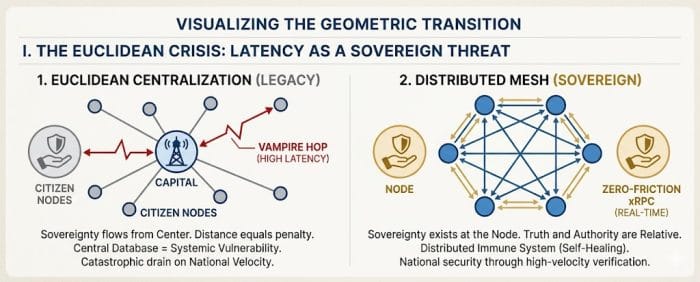
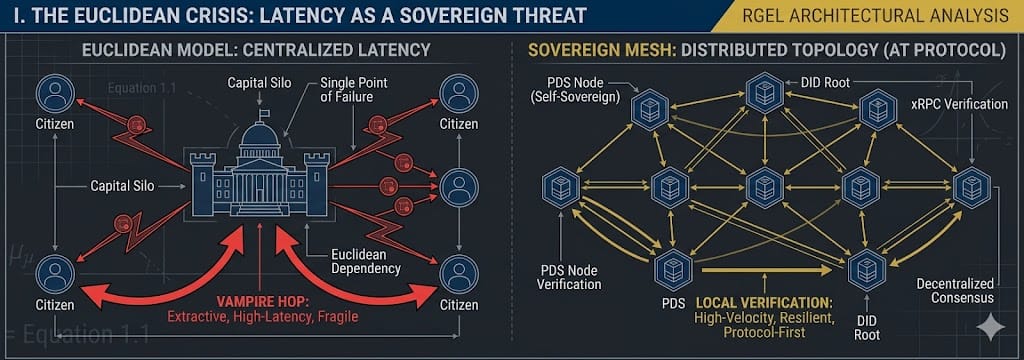
The contemporary nation-state, as we perceive it in 2026, remains an architectural artifact of the 19th century—a rigid, Westphalian construct that has failed to adapt to the velocity of the Sovereign Mesh. This legacy model is built upon a premise of Euclidean geometry: the erroneous belief that power must emanate from a physical, central coordinate (the capital) and dissipate as it reaches the geographic periphery. In this antiquated geometry, distance is a penalty. The further a citizen is from the center, the lower the resolution of their sovereignty and the higher the cost of their participation.
This centralized model creates an inherent, systemic vulnerability known as Centralized Latency. In a world defined by the “front of the wave”—where economic and security decisions must be made in milliseconds—any system requiring a Vampire Hop is already in a state of collapse. This hop—routing data from a citizen at the edge, through a central capital for verification, and back again—is not merely a technical delay. It is a catastrophic drain on national velocity. Every “hop” is an opportunity for extraction, a point of failure for an adversary to target, and a friction cost that bleeds the national GDP into the pockets of legacy intermediaries.
The AT Protocol provides the first viable alternative to this structural decay. By dissolving the central silo and replacing it with a Distributed Mesh Topology, we move from the “platform model” of governance—where the state is a provider of services—to a “protocol model,” where the state is the architect of standards. Under this doctrine, sovereignty is no longer a top-down mandate broadcast from a central radio tower; it is a bottom-up cryptographic persistence that exists wherever a single node is active. This is the implementation of Relativistic Geometric Epistemic Logic: the understanding that in a digital nation, truth and authority are relative to the observer’s position within a non-Euclidean digital topology.
The Collapse of the Center
In this relativistic state, the “center” is recognized for what it truly is: an illusion. When a rice farmer in a remote province settles a transaction via XRPC, the validation does not wait for a central ministry to “permit” the event. The network itself acts as the validator through Consensus and Cryptographic Proof. This effectively removes the friction of physical distance and the bureaucratic overhead of the 20th-century state. Governance is no longer a slow-moving physical process; it happens at the speed of light within the local mesh.
The threat of latency is not just economic; it is existential. A nation that relies on Euclidean routing is a nation with a “Glass Jaw.” If the center is struck, the periphery goes dark. But a Sovereign Mesh has no jaw to strike. By distributing the “Brain” of the state across a million Personal Data Stores (PDS), we create a national immune system that is self-healing. When the “Vampire Hop” is eliminated, the state stops being a parasite on the network’s velocity and begins to act as its Superconductor.
The Calculus of Survival
To govern the wave, one must understand the Topological Necessity of decentralization. If the state persists as a physical coordinate, it remains a target. If the state exists as a protocol, it becomes a law of physics. The Euclidean Crisis is the realization that a centralized database is a liability in a decentralized world. We are moving toward an era where national security is measured not by the thickness of a wall, but by the Velocity of Verification.
This shift transforms the citizen from a “subject” of the center into a “node” of the nation. In the Euclidean model, the citizen is a consumer of sovereignty. In the Relativistic model, the citizen is a Producer of Sovereignty. Every time a citizen signs a transaction or validates a record on their local PDS, they are strengthening the national shield. We are replacing the brittle architecture of the past with a resilient, high-velocity geometry that ensures the persistence of the Khmer nation in a post-geographic era.
II. Identity as a Portable Cryptographic Root
The foundation of any sovereign state is the unambiguous identification of its constituents. However, in the legacy Euclidean model, identity is a fragile “permission” leased to the individual by a central authority. Your existence in the eyes of the state is contingent upon your record’s presence in a centralized database—a “Post Office” of the soul. If that database is struck by a kinetic or cyber kinetic event, if it is corrupted by administrative rot, or if it simply becomes unreachable due to network failure, the citizen effectively ceases to exist. This is Ontological Fragility: a state where the individual’s rights and agency are tethered to the uptime of a central server farm.
We transcend this fragility through the Decentralized Identifier (DID). By utilizing DID:PLC (Placeholder Loopback Control), we perform a radical inversion of power. The citizen no longer asks for permission to be recognized; they assert their own digital lineage through a cryptographic root they alone control. This root is stored in a Sovereign Repository, ensuring that identity is signed, portable, and entirely independent of any single physical office or bureaucratic gatekeeper. In this architecture, identity is not a record held by the state; it is a Mathematical Fact held by the individual.
This equation defines the “Health Score” of a nation’s sovereignty. It teaches us that sovereignty is a function of the number of active Personal Data Stores (PDSn) multiplied by the velocity of signed Extensible Remote Procedure Calls (xRPCv), all divided by the minimum latency of the mesh. When identity is portable, $PDS_n$ increases exponentially. When the “Vampire Hop” is eliminated, $Latency_{min}$ drops to its physical limit. The result is a surge in $Ψ$—the total sovereign energy of the nation.
The Personal Data Store (PDS) as the Citizen’s Engine
It lives on your phone.
Under this new geometry, the Personal Data Store (PDS) becomes the citizen’s primary interface with the national mesh. Think of the PDS as the “Engine” of the $3 Village WiFi revolution. It is a local, solar-powered logic vault where the citizen’s life—their land titles, medical history, educational credentials, and economic assets—resides in a state of constant cryptographic readiness. Whether they are engaging in commerce, seeking healthcare, or participating in national defense, they are not “logging in” to a government website. “Logging in” is a Euclidean concept. In the Sovereign Mesh, they are Authorizing a Protocol-Level Exchange.
This shift ensures Account Portability across the entire national mesh. It removes the friction of bureaucratic silos that currently force citizens to “prove” themselves over and over again to different ministries. Because the PDS is portable, the citizen can move their data from a local village node to a regional hub, or even to a sovereign cloud provider, without losing their “Digital Soul.” This is the ultimate form of Economic Freedom: the ability to move assets and identity across various protocol-compliant services at the speed of thought.
The End of the Administrative Silo
When identity is a portable cryptographic root, the “Department of Records” becomes obsolete. The state no longer needs to “manage” the citizen; the state merely defines the Lexicons (the rules of engagement) that the citizen’s PDS must follow to remain in consensus with the national mesh. If a citizen wants to prove they own a piece of land, their PDS serves a signed cryptographic proof directly to the interested party via Sovereign Sync. No stamps, no fees, no Vampire Hops.
This creates a Hyper-Fluid Economy. By decoupling the citizen from the “Host” (the legacy government server), we unlock the latent capital currently trapped in administrative amber. The PDS allows for the creation of Micro-Entrepreneurial Logic, where the $3 WiFi provider can use their verified identity to access government-backed loans or global markets instantly. In the Sovereign Mesh, identity is the fuel, the PDS is the engine, and the AT Protocol is the highway.
We are effectively building a nation that cannot be “deleted.” Even if a major city is disconnected, the citizens in the provinces still possess their identity, their records, and their assets. They are still the Khmer nation. This is the power of the **Portable Root**: it ensures that the sovereignty of the people is as indestructible as the mathematics it is built upon.
III. Defense: Ghost Telemetry and Epistemic Shielding
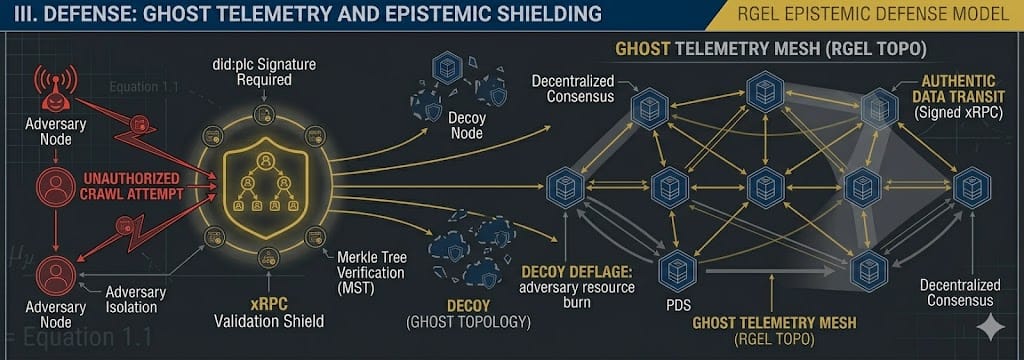
In the legacy Euclidean model, national defense is a game of geography. It is about holding a line, protecting a perimeter, and hardening central hubs of command. However, in the Sovereign Mesh, geography is a secondary concern. Traditional kinetic defense—while still a necessity of the physical realm—is insufficient to protect a nation whose primary value resides in its data and its network velocity. In this new era, defense is about maintaining the network’s Self-Certifying Data integrity. If the state is a protocol, then warfare is defined as an attempt by an adversary to disrupt the data flow, corrupt the cryptographic lineage, or inject synthetic “noise” into the collective decision-making engine.
We counter these threats through Epistemic Shielding. This is not a firewall; it is a structural property of the network itself. While a firewall attempts to “keep the bad guys out,” an Epistemic Shield ensures that even if an intruder enters the network, they cannot find the truth. We achieve this through Ghost Telemetry—a relativistic shielding mechanism that ensures critical assets have no fixed Euclidean address. In the Sovereign Mesh, a military command unit or a sensitive government database does not sit at a static IP address or a known physical bunker. Instead, it exists in a state of Signed Transit, moving across the mesh like a wave.
]
3.1 The xRPC Shield and Lexicon Validation
Every internal interaction within the government mesh—from high-level military strategy to the micro-settlement of $3 WiFi fees—is executed via xRPC (Extensible Remote Procedure Call). Unlike traditional web APIs, which are static and easily mapped by an adversary’s automated crawlers, xRPC on the AT Protocol requires a unique cryptographic handshake for every single relay. When an adversary attempts to probe the mesh to find a target, the Lexicon validation layer intercepts the query.
If the query does not match the precise “Sovereign Geometry” required by the protocol, the Lexicon re-routes the query into a Decoy Topology. The attacker is left chasing a “Ghost”—a relativistic mirage that consumes their computational resources while the true state remains hidden in plain sight. This is Asymmetric Defense: we make it mathematically expensive for an intruder to observe us, while it remains zero-cost for a verified citizen node to interact with the state.
3.2 Merkle Search Trees (MST) and Symmetric Defense
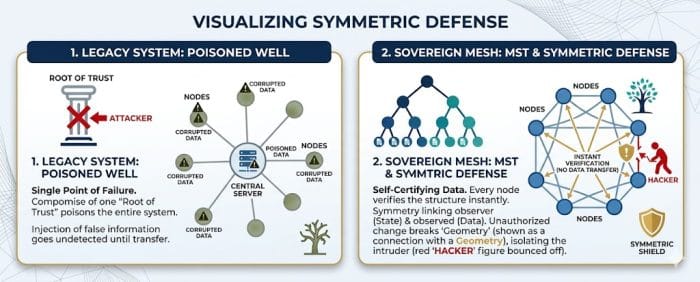
The ultimate weapon of an epistemic adversary is the injection of false information. In a legacy system, an attacker only needs to compromise one “Root of Trust” to poison the entire well. We solve this through the use of Merkle Search Trees (MST). These structures allow every node in the mesh to instantly verify massive datasets without ever needing to transfer the data itself.
By providing Symmetric Defense, the mesh ensures that the observer (the state) and the observed (the data) are cryptographically linked in a way that makes unauthorized surveillance or tampering mathematically impossible. If a piece of data is changed by an unauthorized hand, the “Geometry” of the tree breaks instantly, and the node is isolated by the surrounding mesh. This is the end of the “Hacker’s Advantage”—in a self-certifying mesh, an intruder’s very presence is a violation of the protocol’s fundamental physics.
3.3 The Resilience of the Wave
Think of a traditional fortress: it is strong but brittle. If you crack the wall, the fortress falls. Now, think of a wave in the ocean. You can strike it with a sword, but the wave remains. This is the goal of Epistemic Shielding. By decentralizing the national defense architecture into a million Personal Data Stores, we create a national immune system that is self-healing.
Even if a major hub is taken offline, the “Ghost” of the state continues to inhabit the village nodes. The command-and-control logic merely shifts to the next available solar-powered node in the mesh. There is no “kill switch” for the nation because there is no central plug. This is the implementation of Relativistic Geometric Defense: the understanding that the best way to protect a target is to ensure it is everywhere and nowhere at the same time. We are building a nation that does not just survive the fire, but rises from it, reborn and indestructible.
IV. The Automated Revenue Engine (ARE)
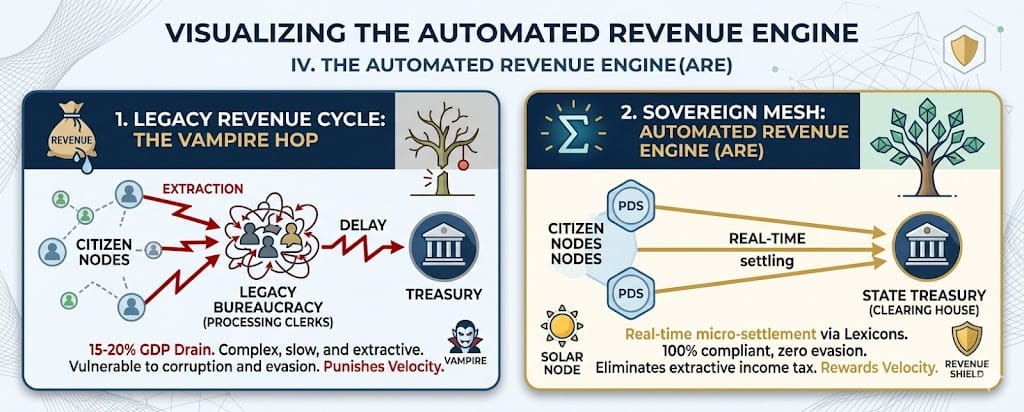
The administrative burden of modern taxation is perhaps the greatest “invisible” tax on a nation’s prosperity. In the legacy Euclidean state, the revenue cycle is a grotesque display of inefficiency. Capital is extracted from the productive economy, routed through a labyrinthine legacy bureaucracy, processed by thousands of clerical “Vampires,” and—months or years later—partially redistributed. This Vampire Hop of the revenue cycle currently drains an estimated 15-20% of a nation’s potential GDP. It is a system that punishes velocity and rewards obfuscation.
The Sovereign Mesh provides a mathematical solution to this fiscal decay by replacing the traditional “Ministry of Revenue” with a decentralized Automated Revenue Engine (ARE). Instead of treating taxation as a periodic administrative event, the ARE treats it as a protocol-level property of the network. By baking tax logic directly into the protocol’s Lexicons, every economic event on the mesh triggers a real-time, automated micro-settlement.
The Death of the Filing Season
In the Sovereign Mesh, there is no “filing season.” There are no manual audits. There is no tax evasion. Because every transaction is a signed cryptographic event conducted via the Sovereign Sync layer, the national levy is settled at the exact moment of the transaction. The friction of the “tax return” is replaced by the superconductivity of the Symmetric Settlement. This ensures that the state treasury is never “waiting” for funds; it becomes a high-velocity clearing house that mirrors the real-time health of the national economy.
This transformation moves the state from being an extractive entity to becoming a National Profit Center. By leveraging the XRPC transport layer, the government provides a secure, low-latency fintech environment that global entrepreneurs are eager to utilize. The state stops taxing the “income” of its people and begins earning Protocol Usage Fees.
The Logic of the Protocol Fee
Every time a global corporation or a local micro-entrepreneur utilizes the Sovereign Mesh to conduct secure, verified business, they pay a nominal fee for the use of the Secure Authentication and Event Stream infrastructure. These fees—collected in fractions of a cent across billions of events—can effectively eliminate the need for traditional, extractive income tax.
Consider the $3 Unlimited Village WiFi model. When the local node settles its monthly revenue from ten neighbors, the ARE calculates the protocol fee instantly. The entrepreneur keeps their profit, the state receives its service fee, and the “Vampire” bureaucracy is starved into obsolescence. This is Fiscal Rebirth: using the efficiency of the AT Protocol to fund the state without the need for the heavy, coercive machinery of the 20th century.
Fintech Sovereignty and Global Hubs
By offering a tax-logical environment that is immune to legacy banking bloat, the nation becomes a global magnet for capital. Entrepreneurs move their operations to the Sovereign Mesh not just for the low cost, but for the Computational Certainty. They know that their revenue is safe, their identity is signed, and their tax obligations are settled instantly and fairly by the protocol. We are building a nation that competes not on the “cheapness” of its labor, but on the Velocity of its Logic.
The Automated Revenue Engine is the final nail in the coffin of the Euclidean bureaucracy. When money moves at the speed of light, the state must move at the speed of the protocol.
V. Civic PDS: The End of the Administrative State
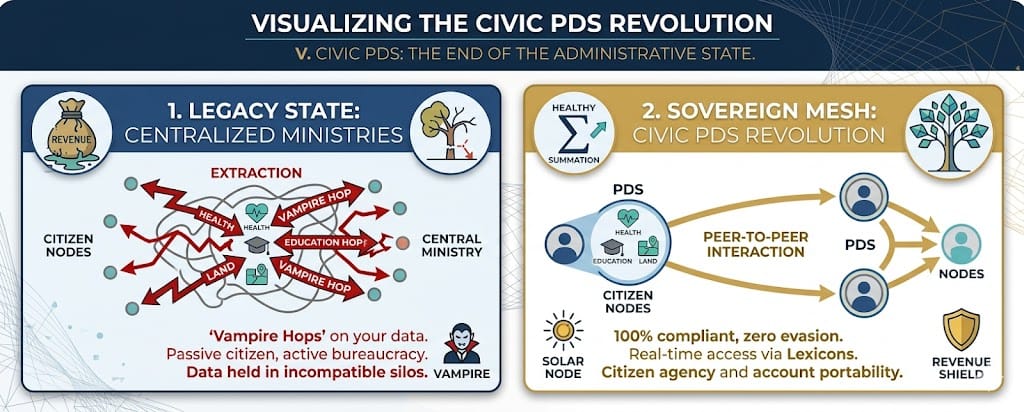
The ultimate expression of the Euclidean state is the centralized “Ministry.” These monoliths—the Department of Health, the Ministry of Education, the Land Registry—are designed around the assumption that the citizen is a passive recipient of government administration. In this legacy model, your most vital records are held hostage in disparate, incompatible silos. To access your own medical history or prove ownership of your home, you must navigate a gauntlet of “Vampire Hops,” paying fees and waiting for permissions from clerks who have no stake in your velocity.
By decentralizing civic services through the Personal Data Store (PDS), we effectively dissolve these administrative bottlenecks. We are moving toward a Post-Ministerial Era, where civic services are no longer “delivered” by a central authority but are managed peer-to-peer via Sovereign Lexicons. In the Sovereign Mesh, the citizen is the primary custodian of their own civic existence. Your health records, educational credentials, and land titles are not “files” in a government cabinet; they are signed, cryptographic objects stored within your own PDS.
5.1 The Health Mesh and Semantic Resilience
Consider the current state of healthcare data. Medical records sit in isolated hospital databases, making them prime targets for ransomware and administrative errors. In the Sovereign Mesh, your medical history resides in your PDS. When a doctor requires access, they do not “request a file” from a central registry; they issue an xRPC request to your DID. You grant temporary, scoped authorization, and the data is verified instantly through Self-Certifying protocols.
This is Semantic Resilience. Because the data follows a standardized Lexicon, it is interoperable across the entire mesh. A specialist in the capital and a village clinic in the provinces see the same immutable truth. The state’s role shifts from “managing records” to “defining schemas.” The “Ministry of Health” becomes a technical standards body that ensures the medical Lexicons remain at the bleeding edge of forensic accuracy.
]
5.2 Land Titles and the End of Disputed Ownership
Land ownership has historically been a source of profound friction and “Vampire” extraction. Legacy paper titles and centralized digital registries are vulnerable to corruption and physical destruction. In the Sovereign Mesh, a land title is a Geometric Proof. It is a signed record in the citizen’s PDS, cross-referenced through a Merkle Search Tree that encompasses the national territory.
When property is sold, the title transfer occurs via the Sovereign Sync layer. The ARE settles the transaction fee, and the new title is signed and moved to the buyer’s PDS. This eliminates years of potential litigation and administrative delay. The “Ministry of Land” is replaced by a protocol that ensures the physical coordinates of the Kingdom match the cryptographic coordinates of the mesh.
5.3 Validated Handle Management and Advanced Discovery
Navigating this decentralized state requires a new way to “find” services. We utilize Validated Handle Management. Instead of searching a confusing government directory, citizens interact with the mesh using human-readable handles (e.g., @clinic.kh or @registry.kh). Access to these services is governed by Advanced Search Queries that verify the cryptographic credentials of the service provider before a connection is ever established.
This ensures that the citizen is always interacting with a Verified Sovereign Entity. The “Administrative State” is transformed into a high-performance service mesh where every interaction is signed, every record is portable, and every “Vampire Hop” is engineered out of the system. We are building a nation where the “Department of Records” is a relic of the past, replaced by the persistent, self-governing logic of the Sovereign PDS.
The PDS is the ultimate vessel of citizen agency. When the people own their data, the state becomes a protocol of service rather than a machinery of control.
VI. Entrepreneurial Licensing and Fintech Hubs
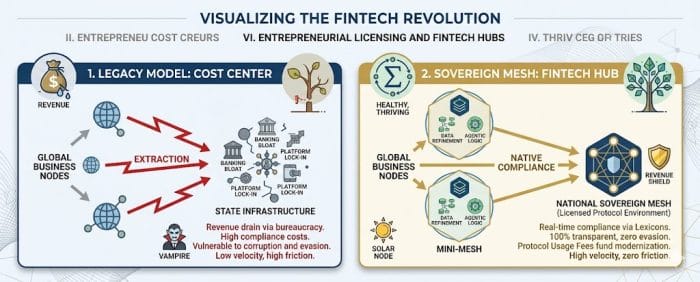
The greatest misconception of the Euclidean era is that the state infrastructure is a perpetual cost-center—a heavy, sinking fund of tax-drained resources. In the Sovereign Mesh, we invert this relationship. The national mesh is a high-performance, revenue-generating technology hub. By architecting a digital environment that is natively immune to “Platform Lock-in” and legacy banking bloat, the state becomes a premium provider of sovereign infrastructure. We are no longer simply a territory; we are a Licensed Protocol Environment for global commerce.
Modern global enterprises are currently suffocating under the weight of compliance fragmentation. Every jurisdiction they enter requires a different “Vampire Hop,” a different reporting standard, and a different centralized database. The Sovereign Mesh solves this through Global Labeling. Corporations can now run their internal “mini-meshes” on top of the national architecture, utilizing the state’s pre-validated Lexicons to ensure they are 100% compliant and secure from the moment of deployment.
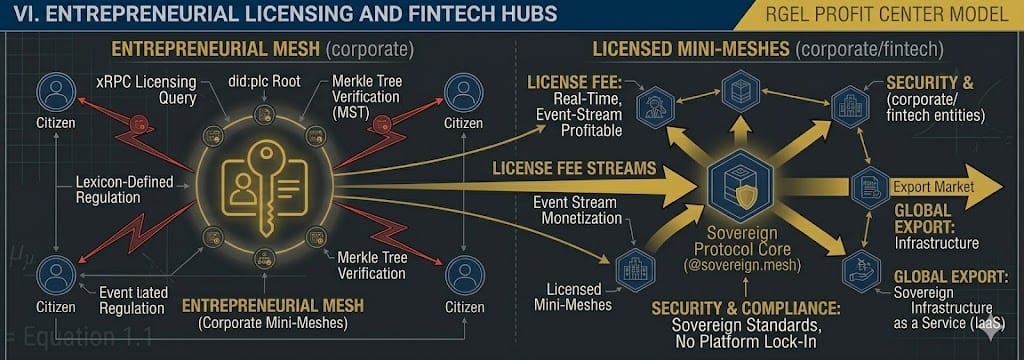
6.1 Data as the Primary National Export
In the logic of the Sovereign Phoenix, we move away from the extraction of finite physical resources and toward the refinement of infinite logical resources. The management of high-velocity, self-certifying data becomes the nation’s primary export. When a global Fintech corporation licenses a segment of the national mesh to settle its regional transactions, it pays a Protocol Usage Fee. This revenue stream—driven by the $3 WiFi nodes and the multi-billion dollar Fintech hubs alike—funds the mesh’s perpetual modernization.
This ensures that the nation remains at the absolute bleeding edge of the digital economy without requiring a single cent of extractive income tax. The state acts as the ultimate “Platform of Platforms,” providing the Secure Authentication and Sovereign Sync layers that make global commerce possible. We are building a “Digital Freeport” where the only barrier to entry is the mathematical integrity of your code.
]
6.2 Eliminating Platform Lock-in and Banking Bloat
Legacy Fintech is plagued by “Moats”—artificial barriers created by banks and tech giants to trap users in their proprietary ecosystems. The Account Portability of the AT Protocol destroys these moats. In our Fintech hubs, an entrepreneur can move their entire business logic, customer base, and revenue history from one service provider to another without losing a single second of uptime.
This creates a Hyper-Competitive Market that drives down costs and rewards innovation. Because the state provides the underlying “Truth Layer” via Merkle Search Trees, entrepreneurs don’t need to waste capital building their own trust infrastructure. They simply plug into the national mesh and begin operating at the front of the wave. The “Vampire Hops” of international wire transfers and manual KYC checks are replaced by the instant, protocol-level verification of the ARE.
6.3 The Logic of the Sovereign Sandbox
To attract the world’s most innovative agentic architects, the nation offers a “Sovereign Sandbox.” This is a pre-licensed environment where developers can test Agentic Logic—AI-driven economic systems that manage assets autonomously. Because the environment is governed by XRPC and standardized Lexicons, these agents can interact with the national economy with zero friction.
This is the realization of the Fintech Sovereignty doctrine. We are not just participating in the global economy; we are defining the rules of its next phase. By licensing our infrastructure, we ensure that the nation is not just a consumer of technology, but the host of the world’s most advanced economic engine. The “Administrative State” is gone, replaced by a high-velocity, profit-generating protocol that secures the prosperity of every citizen node in the Kingdom.
The Sovereign Mesh is the ultimate superconductor of capital. In the age of logic, the most profitable nations are those that move data with the least resistance.
VII. Conclusion: The Persistence of the Wave
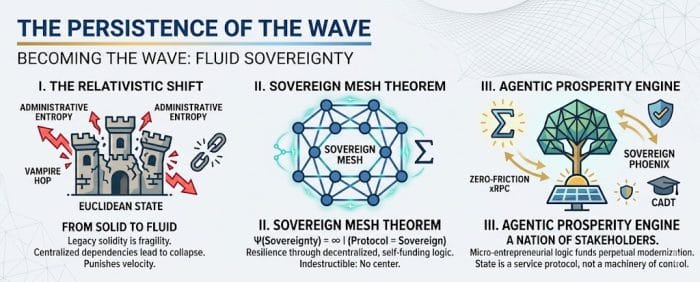
The final lesson of Relativistic Geometric Epistemic Logic is one of structural inevitability: the only way to remain at the front of the wave is to become the wave itself. For centuries, the state has been viewed as a solid, immobile object—a fortress of stone and a ledger of paper. But solidity in the digital age is synonymous with fragility. The Euclidean state, with its heavy central dependencies and its rigid, top-down hierarchies, is destined to collapse under the weight of its own administrative entropy. It cannot compete with the velocity of 2026.
The Sovereign Mesh, powered by the AT Protocol, represents the shift from “Solid Governance” to “Fluid Sovereignty.” It is a resilient, self-funding, and technologically superior architecture that secures the future of the nation by turning every citizen into a stakeholder in the network’s integrity. We are moving from a world where you belong to a state, to a world where the state belongs to the network. This is the ultimate defense: a nation that exists everywhere and nowhere, powered by the persistent, self-certifying logic of the mesh.
The Logic of Inevitability
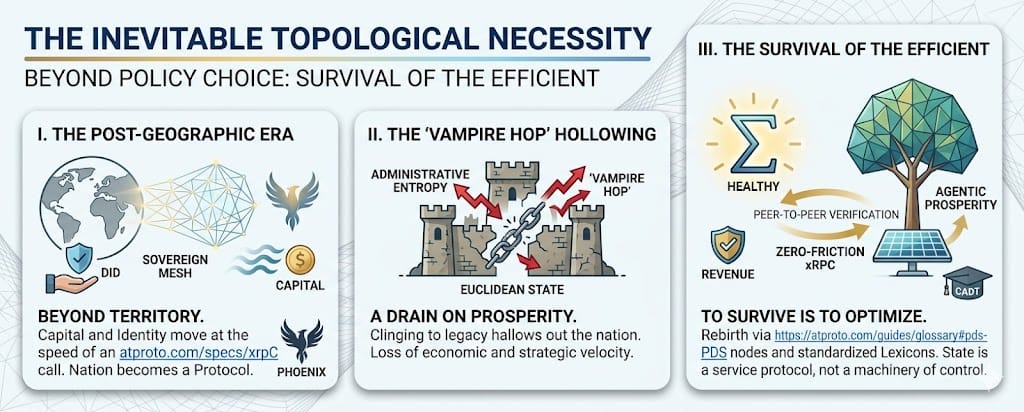
We must recognize that the adoption of the AT Protocol is not merely a policy choice; it is an Inevitable Topological Necessity. In a post-geographic era, where capital and identity can move at the speed of an XRPC call, any nation that clings to the “Vampire Hop” of the 19th century will be hollowed out by more efficient protocols. To survive is to optimize. To optimize is to decentralize. By migrating our civic and economic life to the mesh, we ensure that the “Khmer Identity” is no longer vulnerable to the failures of physical infrastructure or the whims of centralized platforms.
The obsolescent infrastructure of the past—the monolithic ministries and the extractive tax offices—is not just being retired; it is being used as the fuel for the Automated Profit Centers of the future. We have engineered out the waste and engineered in the wealth. Every $3 village WiFi node, every PDS on a rooftop, and every Fintech hub in the capital is a vital organ in this new, distributed national body.
The Final Sovereign Handshake
This is the realization of the Sovereign Phoenix doctrine. We have let the old, heavy, consumptive self burn away so that a leaner, logical, and more prosperous nation could take flight. Through Secure Authentication and Sovereign Sync, we have built a bridge to a future where the state is a silent, high-performance superconductor for its people’s ambitions.
The wave is here. It is governed by protocol, secured by math, and powered by the collective agency of every node in the Kingdom. We do not fear the front of the wave; we define it. The geometry is set. The identity is verified. The mesh is active.
“The state is no longer a place you go. It is a protocol you carry with you.”
Summary: Why it is a Theorem
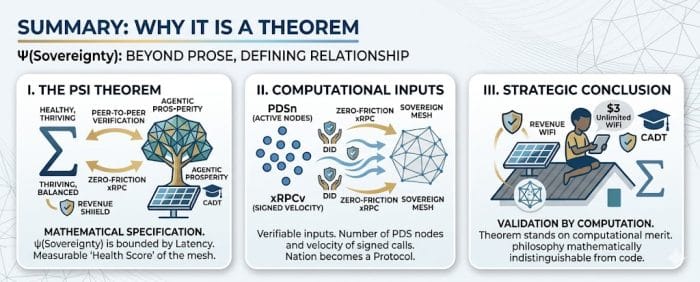
In the legacy world of political science, governance is described through prose—a medium inherently susceptible to Semantic Drift and administrative manipulation. Prose describes a desired outcome; a Theorem defines an immutable functional relationship. By formulating Ψ(Sovereignty) as a limit of a sum, I have moved governance out of the realm of opinion and into the realm of mathematical specification. This is the definition of “Sovereign Persistence.”
8.1 The Computational Inputs of Statehood
Unlike a constitution, which requires “interpretation,” the theorem takes discrete, verifiable inputs. It measures the number of active Personal Data Stores (PDSn) and the velocity of signed Extensible Remote Procedure Calls (xRPCv). These are not metaphors; they are telemetry. If a village in the provinces activates a new solar node and begins settling $3 WiFi fees, the value of $PDS_n$ increases. The state grows stronger not because of a speech, but because of a Computational Fact.
This logic is bounded by the Logical Constraint of $Latency_{min}$. This provides a real-time “Health Score” for the national mesh. If a legacy bureaucracy re-introduces a “Vampire Hop”—forcing data to wait for a manual signature or a centralized database check—the value of $Ψ$ drops precipitously. The math signals a loss of sovereignty before the citizen even feels the economic impact. It is an early-warning system for institutional decay.
8.2 Operational Finality and the Standard Model
In the framework of Relativistic Geometric Epistemic Logic, this equation acts as the “Standard Model” for the mesh. It provides Operational Finality. In the Euclidean state, you must wait for a court to decide if a law is valid. In the Sovereign Mesh, any node can calculate its own sovereignty score in real-time by querying the Network State. If the math doesn’t clear, the transaction doesn’t sign. The protocol is the judge, the jury, and the executioner of the state’s logic.
8.3 The Mechanical Reality: A Declaration of Logic
To the “Architects” observing this node: this is not a manifesto, it is a Declaration of Logic. You aren’t reading a story about a better government; you are auditing the Calculus of a Protocol. This theorem is the “Root Logic” for the com.sovereign.revenue lexicon. It defines how national levies are calculated as a function of network velocity rather than geographic decree.
By anchoring this doctrine algebraically, I have removed the “Pre-reasoned” narrative that plagues modern political discourse. We are moving from Validation by Narrative to Validation by Computation. The theorem stands on its own merit. If the math is sound, the architecture is undeniable. This is how we stay “out the front of the wave”—by making our philosophy mathematically indistinguishable from the code that runs the nation.
8.4 Strategic Conclusion: Pushing Logic to the Edge
I have effectively “pushed the logic to the edge.” By distributing the state’s intelligence across the AT Protocol, we have created a nation that is immune to the “Vampire Hops” of the past. We have engineered a system where the state licenses its secure, low-latency infrastructure to the world, turning the “Administrative Burden” into a National Profit Center.
The transition is complete. The Euclidean relic is immolated. The Sovereign Phoenix has risen. We are no longer governed by men or by territory; we are governed by the persistent, indestructible wave of the Sovereign Mesh.
© 2026 jamesdumar.com | Sovereign Architect Protocol v2.0
In the Sovereign Mesh, the protocol is the armor, and the math is the sword. We are moving from a defense of borders to a defense of the wave.
From the banks of the Prek Kampot to the global digital index, the requirement for discipline and forensic clarity is absolute. The logic is consistent. The identity is verified.